
By Benjamin Huegel,
After centuries of being omitted from the national narrative, 2.6 million African-Mexicans are finally being counted, but the struggle for cultural preservation continues.
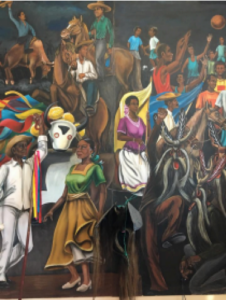
The building itself is unremarkable, at first glance just another commercial building in Costa Chica, vandalised with intricate graffiti. Closer inspection reveals that this is not merely graffiti but a surprising chronicle of a people’s history. It depicts bronze villagers strumming their guitars and, looming over and around them, dramatic dancing devil-men.
Stepping inside, the mural continues, showing luscious landscapes and the portrait of one of the founding members of the country. His hair is dense, and his skin a dark brown. On opposite walls hang photographs of Mexicans wearing traditional attire, but once again, their hair is different, and their skin is darker. This is the Afro-Mexican Museum in Costa Chica, Guerrero, Mexico.
Not long ago there were 68 constitutionally recognised ethnic groups and more than 300 different languages in Mexico. Most populous among these are the Nahuas and the Yucatec, whose roots go back to pre-Hispanic days.
But one group that has been largely unrecognised is the Afro-Mexicans, or Afro-Mestizos, as they are known locally. When the museum in Costa Chica opened in 1999, it was the very first formal recognition. The municipal president likened it to a “stone that says we exist, which will be remembered by visitors for 2,000 years.”
The museum houses a unique collection of photos and displays showcasing the history of this group as far back as the 17th century. One display is a large model of a Spanish galleon split in half to reveal the inhumane conditions in which their “cargo” was transported across the Atlantic. Although history has shown that some Africans arrived voluntarily, most of the original African population arrived in shackles.
By the early 1600s, forced labour and European diseases had largely decimated the indigenous population. Demand for an alternative workforce increased exponentially. Colin A. Palmer, professor of African American Studies at Princeton University, writes that between 1530 and 1640 around 110,500 slaves arrived in what was then New Spain.
It is in these early years of New Spain that Gaspar Yanga, a runaway slave of Congolese descent, led a slave uprising against the Spanish Crown. The newly freed slaves were victorious and established San Lorenzo de los Negros in Veracruz (renamed Yanga in 1932), the first free town in the Americas.
In the last days of the slave trade, more of these free towns sprang up around southern Mexico; Costa Chica is one of them. A diorama at the centre of the museum shows visitors small circular mud huts surrounding a busy market and farmers harvesting their crops.
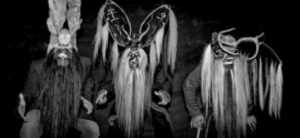
Artefacts belonging to this Afro-Mexican culture are also proudly displayed, among them hollowed-out gourds and ritual masks. Masks like these, adorned with antlers and horsehair, are still used today in the Dance of the Devils, a ritual originally performed by the slaves, as an appeal for the gods to liberate them from Spanish oppression. Few could have guessed that liberation would come, two centuries later, by the hand of their very own descendant.
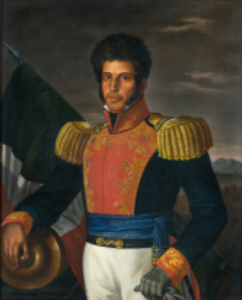
September 16th, 1810, marked the beginning of Mexico’s war against Spanish rule. That same year, Vicente Guerrero, an Afro-mestizo and humble mule driver, joined the struggle, moving quickly up the ranks of the rebel army.
Victory was slow to come. Despite countless defeats, betrayals and the deaths of most of its founding leaders, the movement was kept alive by Guerrero, now a general. Finally, on the 27th of September 1821, he marched into the capital of a newly independent nation, and in 1829 he became the second president of the Mexican Republic.
His policies were revolutionary even by today’s standards. Free education and agrarian reforms that favoured the lower class – the kind of policies that conservative elites won’t accept willingly. Less than nine months into his presidency, Guerrero was betrayed and assassinated. His most celebrated contribution to the country was the abolition of slavery.
As of 2020, Afro-Mexicans represent 2% of the total population (2.6 million). Despite their significant numbers, many Mexicans are not even aware of their existence. One of the reasons is that Afro-Mex identity has long been omitted from the country’s history or, in some cases, completely whitewashed. Guerrero himself is often depicted in paintings and textbooks with white skin and European features.
Few of the contributions mentioned in this article have made their way into state-mandated textbooks. Speaking to the Pulitzer Centre, social anthropologist Gabriela Nieto said that when Black history is incorporated, it is often through the context of slavery: “The participation of Afro-descendants is left out.”

Today, the Costa Chica museum, that stone to serve as a reminder of their existence for 2000
years, faces foreclosure. The founding committee has abandoned it, and its staff has been unpaid for 15 years. Its sole attendant, Angelica Alvarado, acts as curator, tour guide and caretaker. “The doors to the museum must stay open because there are children growing up here who do not want to be Black,” she told the Guardian. “This space shows us where we came from, who we are and why we should be proud of our identity.”
Much like the war for independence, the fight for recognition has been slow, but there is progress. In 2019 the number of recognised ethnic groups increased from 68 to 69 with the addition of the Afro-Mexicans. And 2020 marked the first year that Afro-Mexicans were able to self-identify in the National Census. “We exist,” a Black resident of Costa Chica told the Guardian. “We have a culture, and we proudly say that we’re Mexican.”