
By MarieJoy Agoya and Ivy Wafula,
“We were tired of rooms full of people staring at their phones. So we built a space where we could actually look at each other.” — Lydia Mwikali, founding member.

On a warm Sunday evening in Machakos County, the scent of simmering ginger and garlic chicken wafts through a modest two-bedroom apartment as a handful of young adults slip quietly through the door. Shoes come off, phones drop into a wicker basket near the entrance, and someone calls from the kitchen, “Who brought the ugali this week?”
This is the Sunday Supper Club, part potluck, part group therapy, part board-game battleground, and for its members, a weekly lifeline.
What started as three friends trying to beat loneliness has grown into one of the region’s most intriguing new social rituals, a secular gathering that feels, by design, almost sacred.
“We were tired of pretending we were fine,” says Lydia Mwikali, 25, a public health enthusiast who helped form the club in early 2023. She sits cross-legged on the carpet, balancing a paper bowl of stew on her lap. “We were going out, posting photos, doing all the things you’re supposed to do, yet somehow feeling more isolated than ever.”
Her roommate, Faith Kinyanjui, nods in agreement. “There’s something uniquely lonely about being surrounded by people who are all staring at their phones,” she says. “We wanted something that felt human again.”
At first, they simply met for dinner on Sundays as three friends, with borrowed game night card games and a rule to keep phones out of sight. By the fourth week, each invited another friend. By the tenth, the group had grown to 12.
Now, the Supper Club includes teachers, engineers, small business owners, and freelancers, each arriving with a dish, a story, or a game.
Every gathering follows three gentle but unwavering rules: no phones or other devices go into the basket at the door. “It’s symbolic,” says Lydia. “We’re choosing each other.” Secondly, share something—a meal, a poem, a playlist, a board game, anything that contributes to the evening—and lastly, full presence, where there is no multitasking, no rushing off, and no pretending.
“It sounds strict, but it actually frees you,” says Brian Kilonzo, 29, an IT technician and one of the club’s most enthusiastic members. “You’re not thinking about who’s texting back or what’s happening online. You’re just here.”
He pauses, then adds with a grin, “Also, it turns out people get very competitive when there aren’t phones to distract them. Our Scrabble nights are basically warfare.”
Kenya, like much of the world, is seeing a quiet shift in how young adults socialize. Bars still bustle on weekends, but a growing number are seeking alternatives that feel less transactional and more nourishing.
“Post-pandemic, we’ve observed a meaningful rise in what we call intentional community practices,” explains Dr. Robert Wafula, a social Scientist and Educator at Friends Theological College. Though he is not affiliated with the group, he’s fascinated by it. “People are rebuilding social habits that prioritize depth over breadth. The Sunday Supper Club is a perfect example with a clear structure, where each member is allowed to be vulnerable hence fostering a healthy connection.”
He also points to rising interest in sober meetups, book circles, craft nights, and hiking groups as part of the same movement. “Young adults are asking, ‘How do we find each other again?’ These rituals are the answer.”
Each Sunday, by 7 p.m., the apartment is alive. In the kitchen, someone is plating chapati while two others debate whether pineapple belongs in pasta salad. On the living room floor, a deck of cards is being shuffled with dramatic flair. A speaker plays mellow blend of Kenyan music.
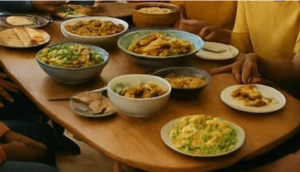
“This is my favorite part,” says Terry, a soft-spoken graphic designer. She’s one of the newer members and admits she nearly didn’t come the first time. “I’d been feeling disconnected from everyone, like my family, old friends, and even myself. But on my first night, someone asked me, ‘How was your week really?’ And I almost cried. No one had asked me that in a long time.”
She’s not alone. Several members describe the group as grounding, even healing.
“I used to have Sunday anxiety,” says Kevin, an accountant who commutes from Nairobi. “Now I look forward to this. It resets me.”
The magic of the Sunday Supper Club isn’t in the food though the food is good. It’s in the consistency, the safety, and the permission to be unguarded.
“Friendship takes work,” Lydia says, “but no one teaches you how to maintain it in adulthood. This is our way of choosing each other every week.”
Brian puts it more simply: “It’s not just a social event. It’s a home.”
As the night winds down, members trickle out into the cool Machakos air, retrieving their phones not with relief, but with a kind of reluctance. They hug longer than typical friends do. Plans are made for next Sunday.
Back inside, the apartment is quiet again, except for the sound of dishes being stacked in the sink.
“It’s funny,” Faith says, wiping the counter. “When we started this, we thought we were just bored. But now I realize, we were starved. Starved for presence. Starved for belonging.” And in a world buzzing with notifications and noise, the simple act of sitting down together every Sunday feels, if not revolutionary, then certainly rare and refreshing. A sacred ritual for a disconnected world.”